Argentina
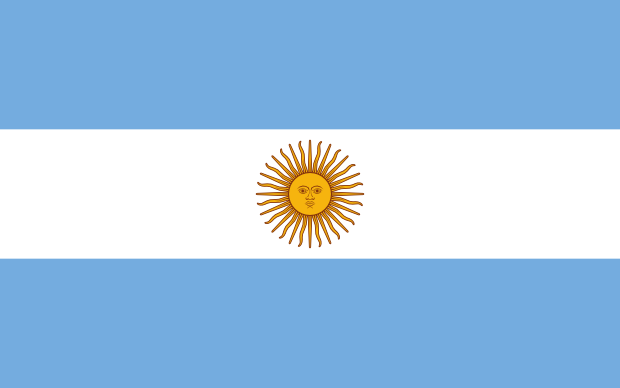
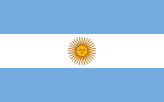
Country flag available in this resolutions
| Icon 32x20 |  |
| Icon 88x55 |  |
Argentina
Argentina: A Land of Vast Landscapes and Rich Heritage
Argentina, officially the Argentine Republic, is a sprawling nation located in the southeastern part of South America. It is the eighth-largest country in the world by land area and the fourth-largest in the Americas. This immense territory encompasses a breathtaking diversity of landscapes, from the arid plains of Patagonia in the south to the lush wetlands of the Iberá and the dramatic peaks of the Andes Mountains in the west. The country shares borders with Bolivia and Paraguay to the north, Brazil and Uruguay to the northeast, and Chile to the west. Its long Atlantic coastline stretches for thousands of kilometers, offering stunning beaches and important port cities. The sheer geographical scale of Argentina has profoundly shaped its history, economy, and the very identity of its people. The fertile Pampas, a vast expanse of grassland, has historically been the agricultural heartland, supporting a robust cattle ranching industry and vast cereal cultivation. Further south, the stark beauty of Patagonia, characterized by glaciers, fjords, and windswept steppes, presents a different, yet equally compelling, natural wonder. The Andean region, with its towering mountains, is a source of mineral wealth and a popular destination for adventure tourism. This geographical mosaic is not merely a backdrop; it is an active participant in the nations story, influencing settlement patterns, economic development, and the cultural tapestry that defines Argentina.
The demographic landscape of Argentina is a fascinating blend of indigenous heritage and significant European immigration. While indigenous populations existed long before European arrival, the dominant cultural and genetic makeup of modern Argentina is largely a result of mass migration, primarily from Italy and Spain, during the late 19th and early 20th centuries. This influx of Europeans profoundly influenced the countrys language, customs, cuisine, and social structures. Buenos Aires, the capital and largest city, is a vibrant metropolis often referred to as the Paris of South America, reflecting its European architectural influences and cosmopolitan atmosphere. The population is predominantly urban, with a high concentration in the Buenos Aires metropolitan area. Spanish is the official language, spoken by the vast majority of the population. While other languages are spoken by immigrant communities and indigenous groups, Spanish is the unifying linguistic force. Argentina boasts a relatively high literacy rate and a well-educated populace, a testament to its historical investment in public education. The country’s demographic profile is characterized by a young population compared to many European nations, although a gradual aging trend is also observed. Religious adherence is predominantly Roman Catholic, a legacy of its colonial past, but other Christian denominations and a growing secular population are also present. The cultural richness of Argentina is further amplified by its diverse population, creating a dynamic and multifaceted society.
Argentina’s economy is characterized by its reliance on natural resources and agricultural exports, though it has also experienced periods of industrial development and technological advancement. Historically, the countrys wealth has been built upon its fertile lands, making it a leading global producer and exporter of agricultural commodities such as soybeans, corn, wheat, and beef. The vast Pampas region continues to be the engine of this agricultural powerhouse, supporting a thriving livestock industry and extensive grain cultivation. Beyond agriculture, Argentina possesses significant mineral resources, including silver, copper, and lithium, the latter becoming increasingly important in the global transition to renewable energy. The country also has substantial natural gas and oil reserves. In terms of industry, Argentina has developed sectors such as automotive manufacturing, food processing, and textiles. However, the Argentine economy has also been marked by periods of significant volatility, including high inflation, currency devaluations, and sovereign debt crises. These economic challenges have often stemmed from a combination of internal policy decisions, global economic fluctuations, and political instability. The government has historically played a significant role in the economy, with varying degrees of intervention and state ownership in key sectors. Despite these challenges, Argentina remains a major player in the regional economy and possesses considerable potential for growth and development, particularly in its agricultural and natural resource sectors, as well as in emerging industries like renewable energy and technology.
The history of Argentina is a complex tapestry woven with threads of indigenous cultures, Spanish colonization, independence movements, periods of political upheaval, and economic transformations. Indigenous peoples, such as the Diaguita, Guaraní, and Mapuche, inhabited the region for millennia before the arrival of Europeans. Spanish colonization began in the 16th century, with the establishment of settlements and the imposition of colonial rule. The Viceroyalty of the Río de la Plata was established in the late 18th century, encompassing a vast territory that would eventually form Argentina and neighboring countries. The early 19th century witnessed a surge of independence movements across South America. Argentina declared its independence from Spain on July 9, 1816, in Tucumán. The decades following independence were marked by internal conflicts between federalists and unitarians, as well as territorial expansion and nation-building. The late 19th and early 20th centuries saw a significant wave of European immigration, which profoundly shaped the countrys demographics and culture, transforming it into a modern nation-state. This era also witnessed economic prosperity driven by agricultural exports. The 20th century was a period of political turbulence, including military dictatorships, democratic interludes, and significant social and economic shifts. The Peronist movement, led by Juan Domingo Perón and his wife Eva Perón, had a profound and lasting impact on Argentine politics and society, championing workers rights and social justice. The latter half of the 20th century was characterized by periods of authoritarian rule, including the brutal military junta of the Proceso de Reorganización Nacional in the 1970s and early 1980s, followed by a return to democracy. Economic challenges, including hyperinflation and debt crises, have continued to be recurring themes in more recent Argentine history. Despite these historical trials, Argentina remains a nation with a rich cultural heritage, a resilient spirit, and a significant presence on the global stage.
Information about country Argentina
Automated text translation, excuse errors, please!
Informations are from the publication CIA The World Factbook.
Country Argentina is situated in a location / continent South America. Argentina has an area of 2 780 400 km2 and 42 192 494 residents. The highest point has a height 6 960 above sea level. and it is called Cerro Aconcagua. The lowest point is located at the level of -105 above sea level and it is named Laguna del Carbon. System of government is republic and the date of independence July 9, 1816. The capital city is Buenos Aires. Argentina has the international abbreviation AR.
Argentina - economy
Total gross domestic product (GDP) is 725 600 000 000 $. Total gross domestic product per capita in purchasing power parity is 17 700 $. GDP grows by 8.90 % a year. Inflation (consumer price index) is equal to 22.00 % a year. Argentina have 16 760 000 working-age population (from a total population 42 192 494 people). Unemployment is at 7.20 %. Argentina issued 9.50 % GDP to healt care and 0,80 % GDP to army. The public debt of the country is 41.40 % GDP. The total amount of foreign debt is 136 800 000 000 USD.
Argentina - transport and telecommunications
Argentina has 231 374 km of roads, 36 966 km of railway lines and 1 149 airports. The total length of waterways (navigable rivers, canals, etc.) is 11 000 km. There is registered 36 ships.
Number of active mobile phones (sim card) in the country Argentina is 55 000 000. Number of active fixed telephone lines is 10 140 000. Argentina has 13 694 000 internet users, who have the available 10 928 000 Internet connections. Argentina has been assigned a domain first Choose range .ar.
Argentina - demography
As suggested above, Argentina has 42 192 494 people. Population growth is in the amount 1.00 % per year. Number of children born per 1000 population per year is 17.34.Every mother has average 2.29 children. The infant mortality rate is 10.52 and maternal mortality 77.00 deaths per 100,000 births. Average estimated life expectancy makes 77.14 years. Mortality is 7.36 people per 1000 population per year.
Argentina - energetics
Argentina consumes a year 104 200 000 000 kWh of electricity. Annual electricity production is 116 000 000 000 kWh in power plants with a total installed electrical capacity 32 070 000 kW. Argentina exports 1 701 000 000 kWh and imports 10 300 000 000 kWh of electricity per year Energy mix of power generation is as follows: fossil fuels: 65.4 %, nuclear energy: 3.2 %, renewable: 0.1 %, hydropower: 28.3 %. The country Argentina is harvested annually 734 000 barrels of oil.
Countries and flags
Bývalých států
Flags
Flags of the World countries
Dále doporučujeme:
Odkazy na partnerské webyZajímavé webové stránky
Odkazy na užitečné webové stránky
Linky na partnerské weby
Zajímavé internetové odkazy
 |
 |
 |
 |
 |
 |
 |
 |
 |
 |
 |
 |
 |
 |
 |
 |
 |
 |
 |