Andorra
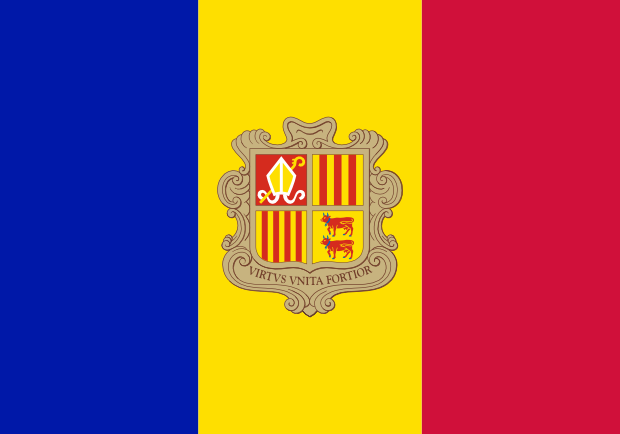
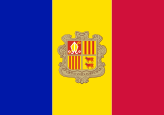
Country flag available in this resolutions
| Icon 32x22 |  |
| Icon 88x62 |  |
Andorra
Andorra, officially the Principality of Andorra, is a tiny, landlocked microstate nestled in the eastern Pyrenees mountains, bordered by France to the north and Spain to the south. Its strategic location, high in the mountains, has played a significant role in shaping its history, culture, and economy. Despite its diminutive size, measuring a mere 468 square kilometers, Andorra possesses a rich and fascinating heritage, a unique political structure, and a surprisingly robust economy. Its mountainous terrain, characterized by steep valleys and towering peaks, offers breathtaking natural beauty and has historically been a barrier to easy access, contributing to its isolation and distinct identity. The countrys highest point, Coma Pedrosa, reaches an elevation of 2,942 meters, underscoring the dramatic topography that defines this principality. The Segre River, originating in the Pyrenees, flows through Andorra, carving out the valleys that are home to its population and settlements. This rugged landscape is not only scenically striking but also dictates much of the country’s economic activities, particularly its reliance on tourism. The climate is alpine, with cold, snowy winters and mild summers, making it an ideal destination for winter sports and summer hiking.
The demographic landscape of Andorra is as unique as its geography. With a population of approximately 80,000 people, it is one of the smallest sovereign states in Europe by population. A striking characteristic is the high proportion of foreign residents. While Andorrans constitute roughly 36% of the population, Spaniards make up the largest foreign group, followed by Portuguese and French citizens. This diverse population has contributed to a vibrant cultural mosaic, though it also presents distinct challenges in terms of national identity and integration. The official language is Catalan, a Romance language spoken in parts of Spain, France, and Italy, but Spanish and French are also widely spoken and understood due to the significant expatriate communities and the country’s close ties with its neighbors. The Andorran people are known for their high life expectancy, a testament to their generally healthy lifestyle and good healthcare system. The population is concentrated in the urban areas, particularly in the capital city, Andorra la Vella, and the surrounding valleys, leaving much of the mountainous interior sparsely populated. The country’s low population density, combined with its high standard of living, creates a unique social dynamic.
Historically, Andorras existence is rooted in a complex feudal arrangement that dates back to the 9th century. The principality was established in 1278 through a co-principality agreement between the Bishop of Urgell in Spain and the Count of Foix in France. This unique dual leadership has persisted for over seven centuries, making Andorra one of the oldest parliamentary democracies in the world. The co-princes, currently the Bishop of Urgell and the President of France, serve as heads of state, though their roles are largely ceremonial in modern times. The countrys history is marked by periods of relative peace and prosperity, punctuated by occasional conflicts and struggles for independence. Its strategic location, however, often protected it from major wars and invasions, allowing it to develop its distinct political and social structures. Over the centuries, Andorra has managed to maintain its sovereignty, a remarkable feat given its size and proximity to larger, more powerful neighbors. Its historical development has been closely intertwined with the development of the Pyrenean region as a whole, but Andorra has always maintained a degree of autonomy.
The Andorran economy is overwhelmingly dominated by tourism and its status as a tax haven. For decades, Andorra has been a prime destination for skiers, hikers, and shoppers, drawn by its stunning mountain scenery and its attractive low-tax regime. The winter sports industry is particularly significant, with world-class ski resorts like Grandvalira and Vallnord attracting hundreds of thousands of visitors annually. Summer tourism, focused on hiking, cycling, and exploring the natural beauty of the Pyrenees, is also a crucial component of the economy. Beyond tourism, Andorra has historically benefited from its low taxation policies, attracting businesses and individuals seeking favorable fiscal conditions. This has led to a thriving financial services sector, although in recent years, Andorra has been under increasing international pressure to align its tax laws with global standards and combat tax evasion. The country has made significant strides in recent years to improve transparency and comply with international regulations, moving away from its image as a purely clandestine financial center. Agriculture, once a vital part of the economy, now plays a minor role, primarily focused on livestock and subsistence farming in the higher valleys. The retail sector is also strong, catering to both tourists and local residents with a wide range of goods.
The political system of Andorra is a unique parliamentary co-principality. As mentioned, the two co-princes, the Bishop of Urgell and the President of France, are the heads of state. However, the day-to-day governance is carried out by a democratically elected parliament, the General Council, and a head of government. The General Council is composed of 28 members, elected for four-year terms. The constitution, adopted in 1993, formalized Andorras status as a sovereign, democratic state and established a clear separation of powers between the co-princes and the government. This constitutional reform was a significant step in Andorra’s modernization, transitioning it from a feudal system to a modern democracy. The legal system is based on Roman law and customary law, with influences from both French and Spanish legal traditions. Andorra is not a member of the European Union, but it has a special relationship with it, enjoying free trade in industrial products and customs union. This arrangement allows it to benefit from EU markets while maintaining its fiscal autonomy. The countrys commitment to peace and neutrality has been a cornerstone of its foreign policy for centuries, allowing it to foster stable relations with its neighbors and maintain its unique identity on the international stage.
Information about country Andorra
Automated text translation, excuse errors, please!
Informations are from the publication CIA The World Factbook.
Country Andorra is situated in a location / continent Europe. Andorra has an area of 468 km2 and 85 082 residents. The highest point has a height 2 946 above sea level. and it is called Coma Pedrosa. The lowest point is located at the level of 840 above sea level and it is named Rio Runer. System of government is republic.The capital city is Andorra la Vella. Andorra has the international abbreviation AN.
Andorra - economy
Total gross domestic product (GDP) is 3 169 000 000 $. Total gross domestic product per capita in purchasing power parity is 37 200 $. GDP grows by -1.80 % a year. Inflation (consumer price index) is equal to 1.60 % a year. Andorra have 38 220 working-age population (from a total population 85 082 people). Unemployment is at 2.90 %. Andorra issued 7.70 % GDP to healt care .
Andorra - transport and telecommunications
Andorra has 320 km of roads.
Number of active mobile phones (sim card) in the country Andorra is 65 000. Number of active fixed telephone lines is 38 400. Andorra has 67 100 internet users, who have the available 28 131 Internet connections. Andorra has been assigned a domain first Choose range .ad.
Andorra - demography
As suggested above, Andorra has 85 082 people. Population growth is in the amount 0.27 % per year. Number of children born per 1000 population per year is 9.26.Every mother has average 1.36 children. The infant mortality rate is 3.76 .Average estimated life expectancy makes 82.50 years. Mortality is 6.52 people per 1000 population per year.
Andorra - energetics
Andorra consumes a year 598 700 000 kWh of electricity. Annual electricity production is 101 000 000 kWh .Andorra exports 9 000 000 kWh and imports 497 700 000 kWh of electricity per year.
Countries and flags
Kazachstán
Flags
Flags of the World countries
Dále doporučujeme:
Naše tipy na zajímavé stránkyTipy na zajímavé weby
Odkazy na partnerské weby
Doporučené odkazy na zajímavé weby
Tipy na Partnerské weby
 |
 |
 |
 |
 |
 |
 |
 |
 |
 |
 |
 |
 |
 |
 |
 |
 |
 |
 |