Algeria
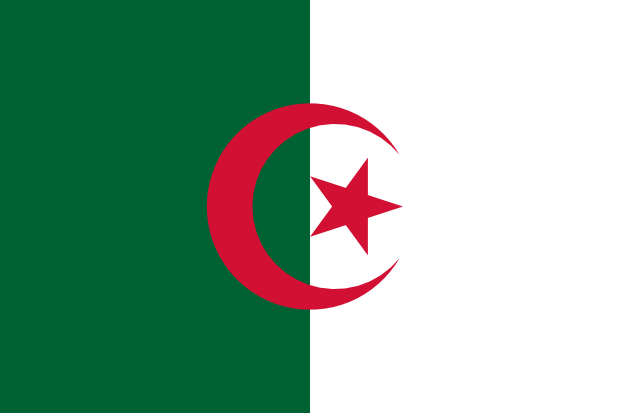
Country flag available in this resolutions
| Icon 32x21 |  |
| Icon 88x59 |  |
Algeria
Algeria, officially the People’s Democratic Republic of Algeria, is the largest country in Africa by area, a vast and diverse land situated in the northernmost part of the continent, bordering the Mediterranean Sea to the north. Its immense size, encompassing over 2.3 million square kilometers, means its geography is incredibly varied, stretching from the fertile coastal plains to the imposing Atlas Mountains and then southwards into the seemingly endless expanse of the Sahara Desert. This geographical diversity has profoundly shaped Algeria’s history, its economy, and the lives of its people. The northern coastal region, characterized by a Mediterranean climate, is where the majority of the population resides and where the country’s agricultural heartland is found. Here, olives, grapes, citrus fruits, and cereals are cultivated, benefiting from the relatively mild winters and warm summers. Inland, the Tell Atlas and Saharan Atlas mountain ranges form a significant barrier, influencing weather patterns and providing a dramatic, rugged landscape. Beyond these mountains lies the Sahara, a colossal desert region that dominates the southern two-thirds of the country. This arid environment, though seemingly inhospitable, is rich in natural resources, most notably hydrocarbons, which have become the bedrock of Algeria’s economy. The Sahara is not devoid of life; oases dot the landscape, providing vital sources of water and supporting small communities, and the nomadic traditions of its inhabitants are a testament to human resilience in extreme conditions. The country’s extensive coastline offers strategic ports and contributes to its maritime activities, while its interior waterways, though limited, play a role in local water management. The sheer scale of Algeria means that internal travel can be challenging, and the vast distances contribute to regional differences in culture and development.
The demographic landscape of Algeria is marked by a young and growing population, with a significant proportion of its citizens under the age of 30. This youthful demographic presents both opportunities and challenges. On one hand, it signifies a potential for economic dynamism and innovation; on the other, it necessitates substantial investment in education, healthcare, and job creation to absorb the influx of young people into the workforce. The population is predominantly concentrated along the Mediterranean coast and in the northern plains, a pattern directly influenced by the country’s geography and the historical development of its urban centers. Cities like Algiers, the capital, Oran, Constantine, and Annaba are major hubs of economic activity and cultural life, attracting internal migration from rural areas and the less populated south. The official languages are Arabic and Tamazight (Berber), reflecting the country’s dual heritage. Arabic is the language of government and education, while Tamazight, with its various dialects, is spoken by a significant minority and is increasingly recognized and promoted as a national language. French, a legacy of the colonial era, remains widely used in business, higher education, and among the educated elite, though its official status has diminished. The vast majority of Algerians are Sunni Muslims, and Islam plays a central role in the cultural and social fabric of the nation, influencing customs, traditions, and daily life. Religious minorities exist, but they are small. Socially, Algerian society is largely characterized by strong family ties and a deep sense of community, with traditional values often holding sway, particularly outside the major urban centers. The rapid urbanization, however, is leading to evolving social dynamics and the emergence of new cultural expressions.
Algeria’s economy is overwhelmingly dominated by its vast reserves of oil and natural gas. These hydrocarbons represent the primary source of export earnings and government revenue, making the country highly susceptible to fluctuations in global energy prices. The state plays a significant role in the economy, with national companies like Sonatrach, the state-owned oil and gas giant, holding a dominant position in the energy sector. While the hydrocarbon sector provides substantial wealth, it has also led to a relative underdevelopment of other economic sectors, creating a dependency that successive governments have sought to address. Diversification of the economy has been a long-standing goal, with efforts to boost agriculture, industry, tourism, and the service sector. The agricultural sector, though capable of producing a variety of crops, is hampered by water scarcity, particularly in the southern regions, and faces challenges in competing with imports. Efforts are being made to improve irrigation techniques and develop drought-resistant crops. The industrial base is present, with a focus on petrochemicals, food processing, and manufacturing, but it often struggles with efficiency and international competitiveness. Tourism holds significant potential, given Algeria’s rich historical sites, diverse landscapes, and beautiful coastline, but it has yet to be fully developed as a major economic contributor, hindered by infrastructure limitations and visa complexities for some nationalities. The informal sector is also a significant, though often unquantified, part of the economy. Unemployment, particularly among young people, remains a persistent challenge, contributing to social pressures and driving emigration. The government is actively seeking foreign investment to stimulate economic growth and create jobs, aiming to reduce the reliance on hydrocarbons and foster a more balanced and sustainable economic future.
The history of Algeria is long and complex, marked by successive waves of settlement, conquest, and resistance. The earliest inhabitants of the region were Berber peoples, who developed distinct cultures and languages. Over millennia, Algeria became a crossroads for various civilizations. The Phoenicians established trading posts along the coast, followed by the Romans, who integrated the region into their empire, leaving behind impressive ruins and a lasting legacy of infrastructure and governance. After the decline of the Roman Empire, the Vandals and then the Byzantines held sway before the arrival of the Arabs in the 7th century CE. This marked a pivotal moment, introducing Islam and the Arabic language, which profoundly shaped Algerian identity. Subsequent centuries saw various Arab and Berber dynasties rule the land, including the Almoravids and Almohads, who extended their influence across North Africa and into Spain. In the 16th century, Algeria came under Ottoman suzerainty, though local rulers, known as beys, often wielded considerable power. This period was characterized by corsair activity in the Mediterranean, which drew the attention of European powers. The most significant chapter in modern Algerian history began in 1830 with the French invasion. What followed was a brutal and protracted colonial conquest that lasted for over a century. The French sought to colonize Algeria, integrating it as an overseas department of France, and implementing policies that often marginalized and exploited the indigenous population. This period of French rule was marked by significant resistance movements, culminating in the Algerian War of Independence, a bloody conflict that raged from 1954 to 1962. The war, characterized by intense guerrilla warfare and significant loss of life on both sides, eventually led to Algeria’s independence. The post-independence era has been a period of nation-building, marked by political challenges, economic development efforts, and a struggle to balance its Arab-Islamic identity with its Berber heritage and its historical ties to Europe. The 1990s were particularly turbulent, with a civil war that erupted following the cancellation of elections that an Islamist party was poised to win. The country has since worked to achieve stability and consolidate its democratic institutions, though the legacy of its tumultuous past continues to shape its present and future.
Information about country Algeria
Automated text translation, excuse errors, please!
Informations are from the publication CIA The World Factbook.
Country Algeria is situated in a location / continent Africa. Algeria has an area of 2 381 741 km2 and 37 367 226 residents. The highest point has a height 3 003 above sea level. and it is called Tahat. The lowest point is located at the level of -40 above sea level and it is named Chott Melrhir. System of government is republic and the date of independence July 5, 1962. The capital city is Algiers. Algeria has the international abbreviation AG.
Algeria - economy
Total gross domestic product (GDP) is 267 000 000 000 $. Total gross domestic product per capita in purchasing power parity is 7 400 $. GDP grows by 2.50 % a year. Inflation (consumer price index) is equal to 4.50 % a year. Algeria have 11 040 000 working-age population (from a total population 37 367 226 people). Unemployment is at 10.00 %. Algeria issued 5.80 % GDP to healt care and 3,30 % GDP to army. The public debt of the country is 8.10 % GDP. The total amount of foreign debt is 4 699 000 000 USD.
Algeria - transport and telecommunications
Algeria has 111 261 km of roads, 3 973 km of railway lines and 142 airports. There is registered 38 ships.
Number of active mobile phones (sim card) in the country Algeria is 35 406 000. Number of active fixed telephone lines is 3 059 000. Algeria has 4 700 000 internet users, who have the available 561 Internet connections. Algeria has been assigned a domain first Choose range .dz.
Algeria - demography
As suggested above, Algeria has 37 367 226 people. Population growth is in the amount 1.17 % per year. Number of children born per 1000 population per year is 16.64.Every mother has average 2.78 children. The infant mortality rate is 24.90 and maternal mortality 97.00 deaths per 100,000 births. Average estimated life expectancy makes 74.73 years. Mortality is 4.72 people per 1000 population per year.
Algeria - energetics
Algeria consumes a year 31 390 000 000 kWh of electricity. Annual electricity production is 40 220 000 000 kWh in power plants with a total installed electrical capacity 10 380 000 kW. Algeria exports 405 000 000 kWh and imports 369 000 000 kWh of electricity per year Energy mix of power generation is as follows: fossil fuels: 97.3 %, nuclear energy: 0 %, renewable: 0.0 %, hydropower: 2.7 %. The country Algeria is harvested annually 1 885 000 barrels of oil.
Countries and flags
Izrael
Flags
Flags of the World countries
Dále doporučujeme:
Doporučené odkazy a zdroje obsahuDoporučené internetové odkazy
Odkazy nejen na naše partnerské weby
Naše tipy na zajímavé stránky
Tipy na užitečné weby
 |
 |
 |
 |
 |
 |
 |
 |
 |
 |
 |
 |
 |
 |
 |
 |
 |
 |
 |